These days, competition is high, and the work environment is increasingly competitive; it is not enough to have only technical skills to succeed. But the power to communicate has now become one of the best career-based skill sets. Be it a meeting, an email, a presentation, or a networking circle, your words will create the pictures of what you say in the minds of those you communicate with. Besides, your language produces a mental image for them. The Power of Words or the Language, say, plays a huge role in who gets promoted at work, who leads the team, who can build relations at the workplace, and whose career gets to move forward.
More than anything, it should be understood that communication is not just about knowing a language inside out. It is through communication that we see, trust, and motivate one another.
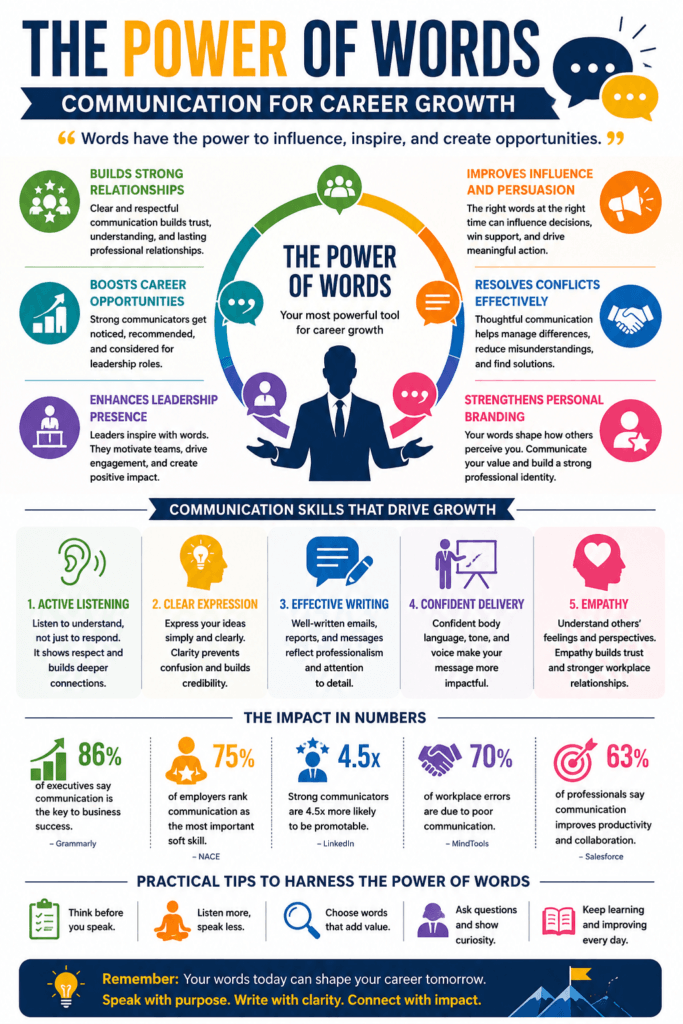
NACE reports that communication skills are valued by employers. LinkedIn’s latest study shows soft skill emphasis is rising across sectors. Companies now prioritize how well candidates express themselves and share ideas. So, understanding the Power of Words is a must-have skill for individuals who wish to enhance their careers and thrive in the current world of work.
Communication skills are one of the characteristics that have a lot aided career progression in my observation.
Indeed, many projects are secured not based on the most qualified technical person but on the basis of effective communication of value.
In this article, we’ll examine the role of communication in career advancement, the power of words, and how workers can leverage language to create successful career paths.
How to Use the Power of Words in Your Professional Success
We all know that words have the power to move, convince, enlighten, and change people’s minds. At our workplace, words can also determine the manner in which people will deal with us, be they our peers, superiors, or clients. For example, showing confidence and respect in our verbal exchanges can, in most cases, earn us people’s trust almost immediately, whereas hasty communication might result in misunderstandings.
Besides that, words also touch on the issues of team functioning at work. The positive mindset of a leader can cause a greater willingness to collaborate among employees as well as higher levels of their engagement. On the contrary, when communication is negative, the outcome will probably be declining morale on one side and lower productivity on the other.
Just take a look at the world’s most famous people, such as Steve Jobs and Oprah Winfrey. One has to say that they did not merely rely on the power of their ideas or skills to make it to the top of their fields. They did the work of talking to people and reaching out to the world piece by piece, turning their industries upside down on an almost unprecedented scale.
And, communication is key in building a personal brand. Your interactions face-to-face, how you present yourself in rooms for presentations, and even the tone of your written communication, like emails, all collectively convey your professional image. This being the case, one must have adequate language to either strengthen the image or message, or, in contrast, lead to a downfall of the image and career.
A communication skill set is a necessity in this digitally oriented world, and a factor that sets one apart from others is the ability to communicate effectively.
Communication Skills Matter More Important Than Ever
Workplace dynamics have really transformed in recent decades. Nowadays, a great number of employees belong to culturally diverse teams, and their main mode of interaction with each other happens to be through digital means. That is the reason why communication skills development has perhaps attracted more focus than ever before in history.
Remote Work Has Increased the Need for Clear Communication
Remote work has brought with it the demand for clear communication. The requirement for unambiguous communication is only increasing as remote work becomes more prevalent.
Written communication plays an extremely important role after the move to remote and hybrid working models. Email, video calls, and employee messaging platforms have become indispensable employee tools. So, when communication is unclear, this may the creation of misunderstandings.
Take the case of a succinct email that might seem unfriendly; Still, you are not going to be the one angry. This way, it is extremely crucial for digitally connected workers to make achieving good communication skills their top priority.
Employers Give Importance or Value Soft Skills Alongside Technical Skills
Alongside technical skills, employers also really appreciate soft skills.
Technical skills will, of course, remain important, but quite a few employers are looking for soft skills increasingly. Communication ranks first on the list of the most desired professional skills all the time, based on LinkedIn’s Global Talent Trends report.
In fact, leaders who do a good job in communication are perceived as the best leaders for their capability to clarify, resolve conflicts, and encourage the team.
Communication Fosters Better Relationships
Having good communication is one of the ways through which better relationships are formed.
Very rarely is career success a one-person task. Yet, career success can greatly depend on one’s relationships with coworkers’ mentor’s clients, and managing staff. Good communication will work toward building these relationships and establishing a foundation of trust and understanding.
The good communicators are the ones who are able to collaborate, network, and lead more often.
Effective Communication and Leadership as Words Power
Effective communication and leadership have always been an important part.
It is no exaggeration that many leadership gurus have identified communication skills as the primary determinant of strong leadership.
Great Leaders Inspire Through the Power of Words
Those who are great leaders inspire through words.
Effective leaders are capable of motivating people through words. They are visionary, directive, and confident even on difficult days.
Mood drops when leadership fails to communicate. So, uncertainty spreads, making staff anxious and unengaged. Well-crafted messages instead of steady spirits, and keep working from now on.
Motivational messages may very well be a great source of positive emotions, and at the same time, they can help keep the levels of productivity high for everyone who receives them. Though if there is no clear communication, then that could easily be seen as a sign of confusion and panic.
Amongst the most famous examples is Winston Churchill’s powerful speeches during the war, which not only inspired hope in the hearts of the people of the nation but also slowly led to the victory over the enemy.
Communication Enhances the Quality of Teamwork
Proper communication improves the experience of teamwork. Transparent communicators who are also leaders are capable of effectively mobilizing teams to work together while also bringing in all related processes, like creativity. If employees not only understand but also are able to appreciate the way communication is carried out, then they will be sharing their ideas more freely and comfortably.
Listening attentively is yet another component of communication. We do not simply pass messages to others, but have a two-way stream of information: talking and listening.
As a team leader, I experienced convincing my employees by coming up with them collaboratively and, most of all, letting them express their ideas. Actually, employees really value a leader who considers their opinions and communicates in a caring way.
Language is Shaping Work Culture
The tone set by language leaders is immediate, direct, and real-life. Positive communication promotes teamworking, creativity, and motivation. In the meantime, negative communication can foster fear and negativity.
Thus, the leadership style has to be carefully used when leaders communicate, as it affects the entire atmosphere of the workplace.
The Power of Words in Career Advancement
Visibility and influence can be key determinants of career development. The key to being “noticeable” in a business presentation is self-assurance.
Effective Communication During Interviews and the Power of Words
Probably the most obvious use of The Power of Words is when preparing to conduct a job interview. Undeniably, one person outshines another even among equal qualifiers because of his or her communication skills. Nevertheless, it is also a reality that those who communicate well make an impression on those who don’t.
For instance, candidates can tell their story better by being confident in their storytelling. Successful professionals share successes and impacts, not responsibility.
Networking Opens Career Opportunities
Networking can provide a lot of career opportunities.
Most noteworthy, networking is the way to a career. Career opportunities are increased through networking.
Communication is also key when networking. Speaking engagements, networking on LinkedIn, and other networking events provide opportunities often.
Networking isn’t a matter of talking much, though. It is more about what and interested than anything else.
It has been beneficial for me to be able to think and express myself online, as well as to find a couple of really good career opportunities. One good e-mail can kick off a business relationship that can last a lifetime.
Learners will have the chance to communicate to make themselves known on the job.
Communication Increases Workplace Visibility
Most importantly, communication and ideas will be more likely to be rewarded. Communication skills are vital to express authority and confidence at meetings, presentations, or collaborative efforts.
Consequently, managers often choose to promote and appoint to leadership positions those who are strong communicators.
The Power of Words in Workplace Relationships
The interaction at workplace is an important factor that influences both work satisfaction and career progress.
Positive Communication Reduces Conflict
Workplaces are sites of conflicts. Though, if you only manage to interact frankly and respectfully, your mis-communications will not become critical and must not explode.
This can, for example, be observed when the transition workers for solutions have healthy workplace interactions instead of blaming people.
Empathy Strengthens Professional Connections
The best thing is that empathy helps to create more positive working relationships.
Empathy – to ‘see’ someone else’s feelings and to understand what they see. Empathic communication leads to improved working relationships between professionals and clients.
In addition, empathetic communication builds trust. Managers who care enough to listen to the emotions of the employee and respect them as human beings will make the employee feel appreciated.
Constructive Feedback Promotes Progress
Positive feedback is provided to ensure that progress is made. Professional development is a very important component, and feedback will be required. The delivery of the feedback however is key.Good words are words which uphold the climb, bad words pull you down. Positive words boost morale, negative words drain them. More importantly, the way in which the feedback is given.
Positive comments will motivate someone to work for improvement and negative comments will probably deflate confidence.
Thus, it is essential that professionals can provide balanced and respectful feedback.
Digital Communications and Career Advancement
With technology, the workplace is forever changed. These days, email, IM, and social networking sites are part of the equation to career success.
Professional Emails Reflect Your Brand
Each e-mail message is a reflection of you. Care is given in the use of professional communication – subject lines, greetings, and language are clear and polite.
For example, an email that doesn’t manage to be written well may result in a misunderstanding or seem unprofessional. The opposite, however, of structured emails is professional and credible emails.
Social Media Communication Matters
Job planning websites such as LinkedIn have actually become an indispensable tool these days. These platforms provide opportunities for learning, networking, and looking for opportunities for professionals.
Digital communication, however, needs to be done with caution. Any negative or inappropriate post can harm the reputation of a professional in a flash.
Virtual Presentations Require Strong Communication Skills
Virtual presentations require good communication skills.
You need to have good communication skills to be able to present virtually, whether you’re going to your client or your target audience.
Web conferences are commonplace in all industries these days. This implies having a solid command of communication, both in video conferencing and virtual presentations.
These include making eye contact, enunciating words, and speaking up to audiences.
How to Improve and Work on Your Communication Skills and Make it Effective
Fortunately, we know how to learn to communicate.
All he/she needs to do is to have a learning/thinking mind and practice.
1. Practice Active Listening
Listening is one of the most underused of the communication skills. Don’t plan your response until the speaker has finished.
Instead, concentrate on only absorbing the communicator’s message.
Teaching active listening is the typical method for establishing the most positive relationships and for avoiding most conflicts.
This is how easy it should be for specialists to express themselves, and how no-one should be able to have any difficulty comprehending them.
2. Expand Your Vocabulary
The professionals should be fluent and slow their speech. Additionally, the professionals must be expert in the language with which they are working. It should be concise and easily understood.
You can learn your vocabulary naturally by reading books, articles, and information about your industry; all these can help you in this.
3. Improve Public Speaking Skills and Build Confidence
Public speaking is a useful skill at work that you can learn. If you can get into a speaking group or give a couple of presentations, you’ll get a lot of confidence out of it. I was shy and fearful to speak to the public, and so was I.
And as the days and life is moving ahead, I feel that I became more professional as well as more confident.
4. Learn Emotional Intelligence
EI is the ability to recognize and feel with others, the universal emotions of professionals. This is a skill that is helpful in persuading, negotiation, and leading.
5. Feedback Advantage
You can take critiques from your mentors, other staff members, or managers on how well you are communicating.
The Power of Words in Personal Branding
Personal branding is the professional image that you have created for yourself. Communication is a pivotal part of that perception.
Your Words Reflect Your Professional Identity
Your communication style is your personality and your expertise – online or off.
In fact, rational and transparent communication is more a truth-telling and reliable indicator of your professional identity.
Storytelling Creates Impact and The Power of Words
Storytelling is a tool that works with less effort, creating an impact. Apart from that, it makes facts unforgettable and connects them by feelings, not only by sharing the facts.
Many of the most famous speakers will harness their own personal daily experience to be able to move their audience through their speech.
Consistency Builds Trust
Repeated communication fosters professional identity. When your tone, values, and messaging stay the same, people will more readily believe and recall you.
Real-Life Examples of The Power of Words
Communication has affected industries and movements throughout history, and also careers.
Steve Jobs and Product Launches and The Power of Words
Steve Jobs communicated technology in a straightforward yet in an inspiring way. His style of communication generated enthusiasm for products and strengthened the Apple brand all over the world.
Oprah Winfrey’s Emotional Connection and The Power of Words
Her great success was in her emotional involvement with the people, as she worked to find the right route. Oprah is a globally famous personality as she is one of the premier names in media because of her sincere and effective communication with her audiences.
Everyday Workplace Communication and The Power of Words
In everyday careers, communication makes a difference, even without the celebrity examples. People who can communicate ideas effectively, assist fellow workers, and deal with disagreements well are likely to make more rapid progress in a company.
Common Communication Mistakes to Avoid
These are some of the classic communication blunders one should avoid:
We all know that communication can be a great source of power. However, a few bad habits can also weaken it and hinder your professional growth.
1. Poor Listening Habits
It is a fact that interrupting others or not listening to them can make them feel bad.
2. Overcomplicated Language
Difficult words could be a handicap rather than a help when presenting.
3. Negative Communication
Frequent complaints or criticism have the potential to affect work relationships and professional image.
4. Ignoring Nonverbal Communication
Ignoring nonverbal communication besides the words, other factors like body posture, facial gestures, and voice modulation can also change the effect of communication. That means it is crucial for working people to observe nonverbal gestures.
The Future of Communication in Career Growth
Good communication will be very important in career growth in the future.
As offices change, they keep making it clearer that communication is a fundamental skill.
Sure, the introduction of AI, machines, and digital tools for collaborating could bring a decrease in technical job opportunities. Still, communication skills will be very important since companies work based on relationships, trust, and leadership.
In addition, people who can adapt their communication styles to new technologies and changing work settings may gain some advantages in the market.
Because of this, upgrading one’s communication abilities is essentially preparing for a successful and sustainable career.
Conclusion: The Power of Words Can Transform Your Career
To sum up, words are much more than speaking. How we communicate can affect leadership colleagues’ career paths and even one’s personal branding. Career plateaus can affect professionals at every stage of growth. Communication skills are one of those magic secrets that differentiate those who make it from those who miss out. And, words create the perception of a person’s self-assurance, competence, and credibility.
Good communication can motivate teams, solidify networks, defuse conflicts, and generate opportunities not provided by technical skills.
I think it’s one of the professional skills that anybody can learn from personal experience, which is communication. Through writing, speaking, and listening, meaningful connections make a difference!
With a digital and competitive workplace, communication will remain the deciding factor in professional success. As such, those who know and practice the Power of Words and strive to enhance their communication abilities will find themselves at the forefront of their career development and for leadership roles.
Umaimah is an SEO strategist with 5+ years of experience in digital content and growth systems. She founded Ambition Inside to publish structured, research-driven insights on productivity, career strategy, and AI-driven business growth. Learn more on the About page.










Excellent work. It is the kind of article that makes readers pause and think about how powerful communication really is.
Thanks
Great effort and excellent thought process from the author. The message is strong, the writing is graceful, and the overall impact is very positive.
Thanks.