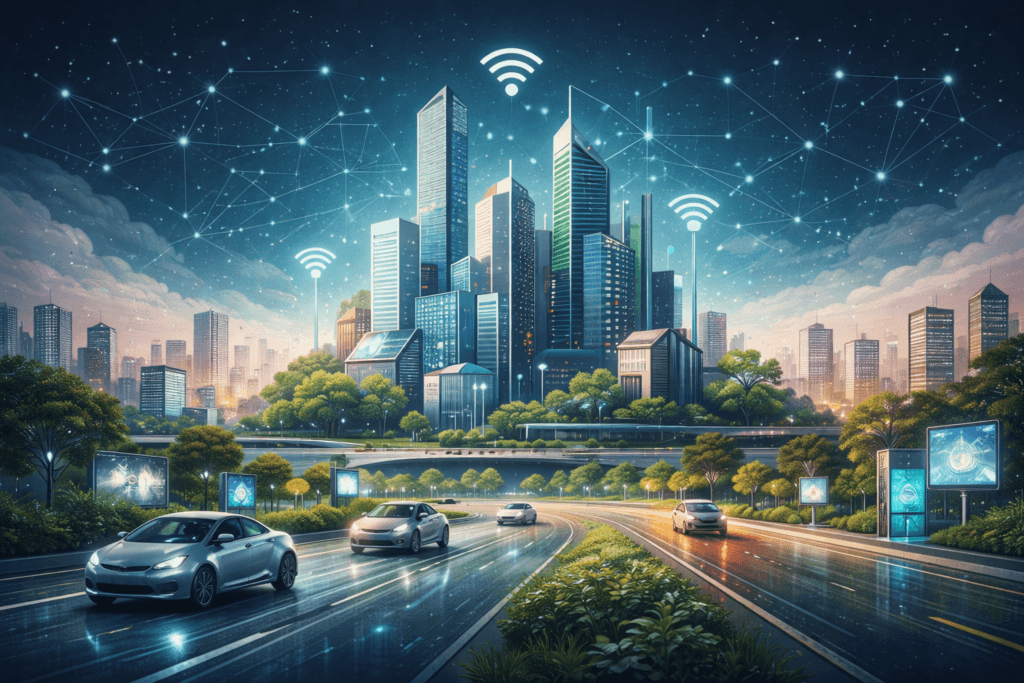
With the population in urban areas continuing to increase at an alarming rate, cities are being challenged in ways never before encountered, including traffic jams, pollution, and poor management of resources. Thus, future city models and future city examples are becoming the favored new design to restructure people of, working in, and interacting with cities in the future.
As a matter of fact, according to my experience of analyzing the trends of innovations and digital transformation, the idea of smart and future cities is not a hypothetical one anymore; it is a reality that already takes place. In addition, these cities are run on such technologies as artificial intelligence (AI), the Internet of Things (IoT), and sustainable infrastructure.
In this article, we will discuss the examples of such cities of the future, the technologies that are used in these cities. Furthermore, how they are transforming the way people live in these cities in ways that most people do not fully understand yet.
What Are Future Cities? (Understanding the Concept)
It is best to know what makes up a future city before getting into the actual examples of future cities.
An urban area that is best and employs sophisticated technologies to enhance its capabilities is defined as a future city, also known as a smart city:
Infrastructure
Transportation
Energy usage
Public services
Nonetheless, in contrast to the conventional cities, these systems are interlinked. One such example is a scenario where the traffic system can send messages to the cars, and on the other hand, buildings can automatically adjust how much energy they consume.
Therefore, cities evolve into efficient, environmentally friendly, and living spaces that people would like to see.
Technologies Future City Examples
Here, we come to technologies which, according to us, will be very familiar in the cities of the future.
AI
Simply put, without AI, we cannot imagine the future of cities. It is the brain behind helping cities handle enormous streams of data in the moment.
Consider the following:
AI predicts where and when the roads will get congested.
AI manages the delivery of energy.
AI makes the protective mechanisms of people work better.
Therefore, decisions are made rapidly and accurately.
IoT
Moreover, IoT links the devices throughout the city.
Examples include:
Smart traffic lights
Connected sensors
Intelligent garbage handling systems
Due to this connectivity, cities are able to react immediately to alterations.
Thus, the expenses on maintenance are minimized to a great extent.
Renewable Energy Systems in Future City Examples
Sustainability in future cities is another important aspect.
The cities of the future are dependent on:
Different Solar panels
Wind energy
Smart grids
Due to this, cities lower the amount of carbon emissions, and at the same time, they are efficient.
Actual future city can be seen changing the life of urban life.
Next, here, we will consider some of the real-world examples of future cities. Thus, they demonstrates how technology is already influencing urban settings.
Singapore: The Most Smart and Intelligent Nation
Singapore is traditionally regarded as one of the best examples of future cities.
Why?
Traffic management AI helps to alleviate congestion
Smart sensors are used to observe the conditions of the environment
Digital identity systems simplify the provision of services to the public
In addition to that, Singapore employs predictive analytics to enhance the planning of the city.
Takeaway: This demonstrates how making decisions that are informed by data can change the whole city.
Dubai: Dubai Innovation at Scale
Another good example is Dubai.
It is in the process of implementing:
Autonomous transportation
Blockchain-based governance
Another one is AI-driven policing systems
Moreover, one of the most famous place Dubai also strives to become one of the smartest cities in the world.
Insight: Government vision is a significant factor in developing future cities.
Tokyo: Best Technology and Efficiency
Tokyo is one of the most popular cities that is efficient as well as advanced in technology.
Key features:
Smart transportation networks
Disaster prediction systems
Best Energy-efficient buildings
Therefore, Tokyo remains one of the most difficult and efficient cities.
Amsterdam: Sustainability First
Amsterdam is a city highly concerned with sustainability.
The city implements:
Smart power grids
Roads and facilities that cater to bicycles
Practices of the circular economy
The Future City Examples and the Way They Make Life Better
So now you may be asking yourself, but what is the actual effect of these examples of future cities on the normal day-to-day life?
We can divide it up.
Smarter Transportation in Future City Examples
To begin with, traffic is made more efficient.
AI reduces congestion
Self-driving cars are efficient in route optimization
Smart parking systems are time-saving
Commuting is thus made quicker and less stressful.
Energy Efficiency in Future City Examples
Secondly, the use of energy becomes better.
Smart grids are efficient in the distribution of electricity
Power consumption of buildings is adjusted automatically.
Thus, the waste of energy is reduced to a minimum.
Better Public Services in Future City Examples
Also, the quality of the public services has increased.
Faster emergency response
Efficient healthcare systems
Real-time data monitoring
This means that the living conditions of the citizens and their quality is improved.
Best Environmental Benefits of Future City Examples
Lastly, the cities of the future are stable and sustainable.
Reduced pollution
Increased green spaces
Efficient waste management
In this way, cities are healthier to reside in.
Caution: Future City Development Challenges
Nevertheless, along with the advantages, the examples of cities in the future also have difficulties.
Privacy Concerns
As the cities gather large quantities of information, privacy is an issue.
Hence, governments should make sure to protect data.
High Implementation Costs
The development of smart infrastructure is costly.
Consequently, these technologies cannot be rapidly implemented in all cities.
Digital Divide
In addition, not all persons have equal access to technology.
This may bring disparity in urban areas.
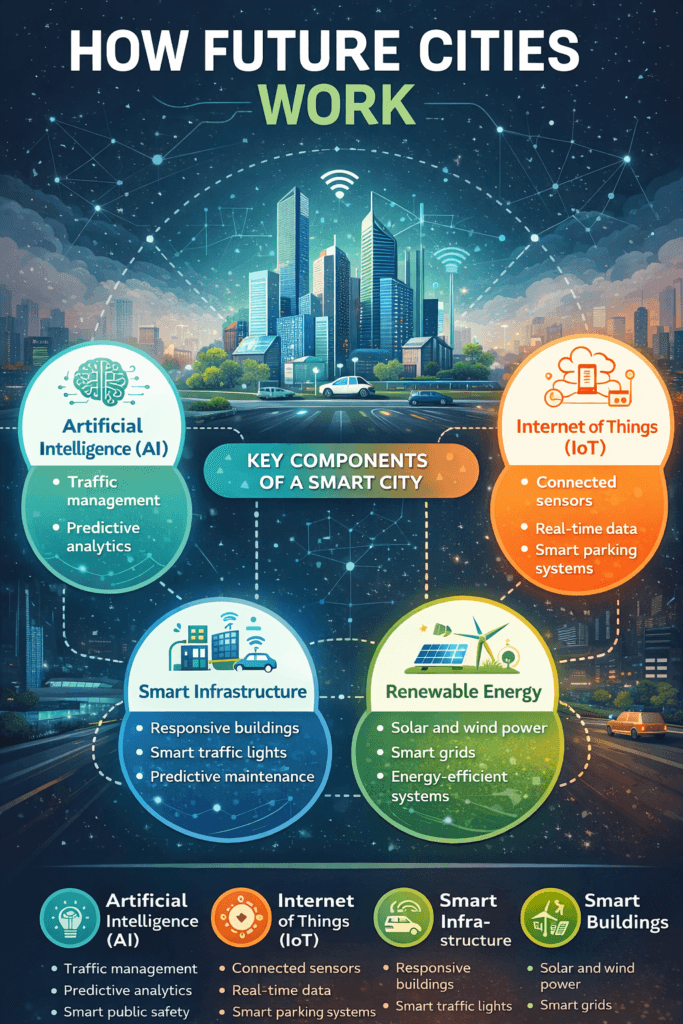
How Future Cities Work
This infographic describes the ways in which the examples of cities of the future are powered up through a combination of the most advanced technologies, including artificial intelligence, the Internet of Things (IoT), smart infrastructure, and renewable energy systems.
Also, these technologies are very much connected with one another.For instance, if we consider IoT sensors, those small gadgets collect real-time information that AI studies to optimize the operation of traffic, energy, and public services, to mention a few.Maybe that explains why the subsequent versions of cities are highly efficient, sustainable, and more attuned to human needs.
Thus, it is clear how these systems interact, and therefore have a clear vision as to how cities are transforming into intelligent ecosystems in the present day.
The Future of Urban Living
In the future, examples of future cities will keep on changing.
We can expect:
Complete independent transport systems
AI-managed public services
Finally, carbon-neutral cities
Furthermore, the technological innovations will further enhances or integrate, and streamline cities.
Expert Insight (E-E-A-T Demonstration)
It is difficult to overemphasize one of the most important observations based on my experience in analyzing the trends of innovation and the digital ecosystem:
Technology combined with human needs in the cities is the most successful.
That is, technology is not sufficient. Rather, it has to be put into practice in a considered manner to enhance real-life experiences.
This is precisely the difference between successful examples of future cities and unsuccessful projects.
How AI Is Helping Future City Examples in Real Time
Speaking of the examples of future cities, artificial intelligence is not only a feature of the city but the foundation of the modern city system. Indeed, AI enables cities to operate virtually as living organisms capable of sensing, analyzing, and reacting within a few seconds.
As an example, AI-based surveillance systems are capable of identifying suspicious behaviors within large groups of people. Consequently, the governments can respond to emergencies in a shorter time. Likewise, AI algorithms can analyze traffic data used to dynamically adjust the signal timings. Therefore, there is less congestion, and it does not involve human intervention.
Apart from that, AI is being employed in predictive maintenance more frequently. Nowadays, cities do not have to wait for a complete breakdown of their infrastructures, and instead can predict when roads, bridges, or utilities are in need of repair.
This is one of the main lessons that I learned during my study of the topic of innovation ecosystems: those cities that are able to leverage AI effectively can achieve faster scaling solutions and provide better services to the citizens.
IoT Sensor Applications in Future City Examples
One more key component of the future urban centers is IoT.(Internet of Things) is another major feature of future cities.Small, networked devices distributed throughout the city collect data continuously.
For example, a smart trash bin has the capability to send its sensors’ data to the waste collection team indicating that the trash is full.
So, in this way, trash collection will be, at the same time efficient and inexpensive.
Besides, pollution levels checking also takes place non-stop by the air quality sensors. Consequently, law-enforcing bodies can initiate instant action when pollution increases.
Moreover, intelligent parking systems apply IoT sensors to identify the free parking spots. The drivers are then able to find parking spots by using mobile applications, which saves a lot of time and fuel.
Due to such systems, cities are more responsive and adaptive. To put it otherwise, IoT is the nervous system of the cities in the future.
Future Cities: Emerging Innovations that Will Change the Future
Although the existing examples of a future city are already amazing, there are several emerging technologies that will continue to transform the way of life in a city.
Digital Twins
A digital twin is a computer simulation of a city. Planners are able to simulate changes using real-time data before the application of changes in the real world.
As an example, prior to constructing a new road, cities can simulate its effect on traffic in a digital environment. Consequently, automation reduces errors to a minimum and enhances efficiency.
5G and Beyond
Having very fast connectivity is a must for smart cities. 5G networks are the ones that actually make it possible for the devices to talk to each other immediately.
So:
Autonomous cars can be safe on the road
Emergency systems get there faster
Real-time data processing without interruption
Autonomous Public Transport
Self-driving buses and trains are no longer just a dream in the case of the cities of the future – they are becoming a reality.
The transportation sector has serious potential for human errors, while self-driving vehicles are likely to reduce that possibility, thereby improving efficiency. Besides, they can operate round the clock, thereby making public transport more accessible.
Smart Water Management
The problem of water scarcity is on the increase. Nevertheless, the upcoming cities are solving this with smart systems.
For example:
Sensors immediately detect leaks
AI predicts water demand
Recycling systems maximize use
Cities are therefore able to save on water.
Smart Buildings: The Heart of Future Cities
Besides infrastructure, even buildings are becoming smart in contemporary examples of future cities.
In order to produce the most efficient results, designers of intelligent buildings integrate sensors and automation that help optimize:
Lighting
Temperature
Energy consumption
Take the case of a smart office with a lighting system that only gets activated when the presence of a person is detected in the room.Such a way will surely result in minimal energy wastage since the occupants simply use no more energy than is necessary.
Besides that, it is possible for people living in smart homes to turn their appliances on and off remotely.
Also, it is a significant improvement, about convenience as well as saving of energy.
To put it another way, smart home allows the residents to control the appliances remotely.
This not only enhances convenience but also efficiency.
Interestingly, green buildings are also becoming more common. Likewise, builders mainly compose such structures from eco-friendly materials and renewable energy sources. Therefore, such buildings can protect the environment.
Economic Opportunities Developed by Future Cities
In addition to technology, the examples of future cities also provide certain economic opportunities.
To begin with, they create new employment positions like:
AI engineers
Data analysts
Urban technology specialists
Secondly, smart city solutions have startups emerging around them. As a case in point, mobile, energy, and automation companies are increasing at a high rate.
Moreover, governments are putting a lot of money into innovation. This results in higher funding and business opportunities for the entrepreneurs.
Practically, it implies that those who are aware of these trends can put themselves in line with future careers.
Lessons Learned: We based the lessons learned on what we have already implemented in the existing future city examples.
Examples of urban future cities today can be studied to learn a lot.
Integration is Key
Technology should collaborate, not alone.
Citizen-Centric Design
The solutions should enhance the lives of people and not make it complicated.
Scalability Matters
Cities should have the capability to scale up systems with an increase in population.
Sustainability is Essential
The solutions are environmentally friendly, and long-term success depends on these solutions.
Future City Examples vs Traditional Cities
Traditional Cities:
Reactive systems
Manual processes
High energy consumption
Limited data usage
Future Cities:
Proactive systems
Automated processes
Then, energy-efficient infrastructure
Finally, data-driven decisions
The trend of evolving to the future examples of cities is one of the significant changes in the development of cities.
Why Developing Countries are Emulating Future City Models
Interestingly, most of the developing countries are currently adopting the models of future cities.
This is because:
They can avoid the outdated infrastructure
Embrace the new technologies at hand
Enhance urban planning at a faster rate
As an example, developers in Asia and the Middle East are constructing new smart city development projects as greenfield projects using new technologies.
Consequently, such cities tend to be innovation centers.
What Will Future City Exemplifications Be in 2040?
In the future, the examples of future cities will be even more developed.
We can expect:
Complete self-sufficient transportation systems
AI-managed healthcare systems
Zero-emission buildings
Hyper-connected urban ecosystems
And, cities will be able to rearrange their offers into personal versions changing an individual’s preferences on the spot.
Thus, the notion of cities will transform the stationary environment into a dynamic system.
Conclusion: Why Future City Examples Are the Future
Finally, the future examples of cities are not only the question of high-tech systems, but also the question of the new approaches to the organization of cities and their life. As we have observed, these cities apply AI, IoT, and sustainable systems to produce more efficient, habitable, and more environmentally friendly environments. In addition, they offer solutions to some of the largest challenges that modern cities have to deal with today. Thus, people interested in government, business, and their own future must comprehend examples of future cities.
Umaimah is an SEO strategist with 5+ years of experience in digital content and growth systems. She founded Ambition Inside to publish structured, research-driven insights on productivity, career strategy, and AI-driven business growth. Learn more on the About page.
2 thoughts on “Future City Examples: How Technology is Transforming Urban Life”
ASAD ZAFAR
This article stands out in a real way! clear, meaningful, and worth every second, Author explained beautifully How Future Cities will look after transformation and I liked how you explained the Key Components of a Smart City is amazing! Overall the article is excellent.











This article stands out in a real way! clear, meaningful, and worth every second, Author explained beautifully How Future Cities will look after transformation and I liked how you explained the Key Components of a Smart City is amazing! Overall the article is excellent.
Thank you.