Each founder, in one way or another, dives into the world of Entrepreneurship Lessons for Startups, but the truth is that the most beneficial lessons are usually not the ones learned from SUCCESS. Rather, they are learned from mistakes, failures, and near-business collapse.
In this article, you will get to know genuine Entrepreneurship Lessons for Startups from the experience of a budding entrepreneur who almost lost everything and only then realized what really makes a business successful.
The Entrepreneurship Lessons for Startups in the Beginning
Arman was 24 years old, a bright, young and talented graduate full of zeal. It did not align with his idea of a good life to be stuck at a desk for someone else.
At the beginning, he pointed out productivity as the leading issue that people have. To this, he developed a productivity tool that helps to combine managing of tasks, time and reminders into one app.
He put all his money into it and, with his little team, worked day and night.
Furthermore, he launched the app live in 3 months.
Unfortunately, things didn’t go as he wished and thought.
Users downloaded the app but didn’t really engage with it. So, user engagement levels after the first session plummeted.
At the same time, income stayed close to zero.
Still, Arman was whispering to himself that upgrading features would be the way out.
Entrepreneurship Lessons for Startups: When the Real Challenge Hits
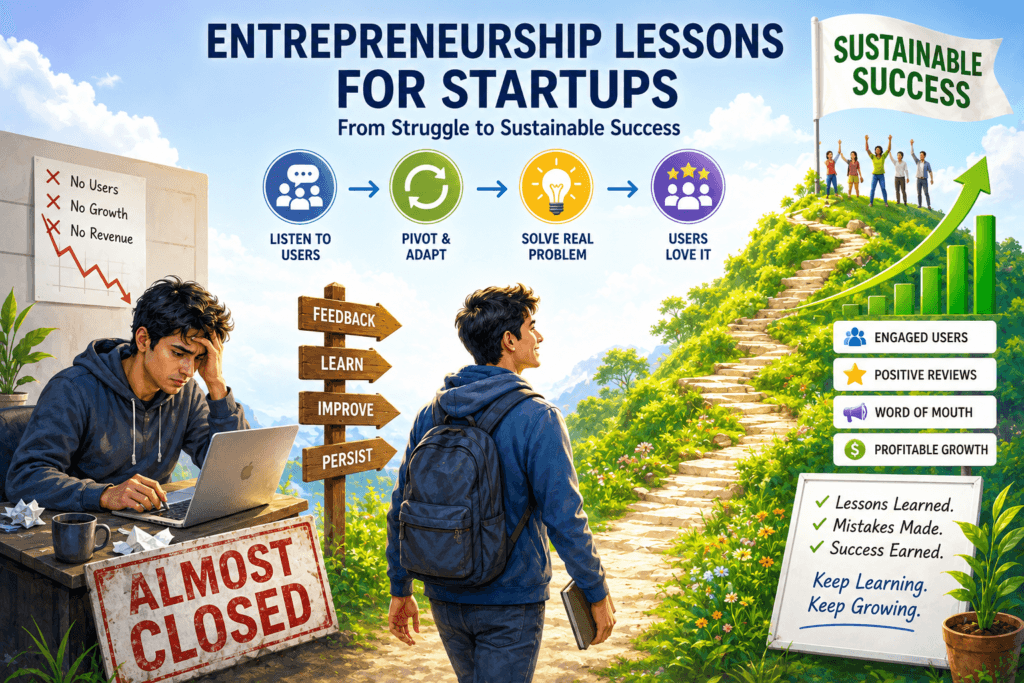
Six months later, the matter was almost out of control.
His savings were nearly finished. In addition, his team started losing motivation. Friends and family advised him to stop and return to a stable job.
However, Arman refused to give up.
Instead, he decided to study his users deeply. Therefore, he started collecting feedback through emails, interviews, and surveys.
Moreover, he analyzed user behavior inside the app. As a result, he discovered something surprising.
People were not struggling with productivity tools. Instead, they were struggling with distractions and lack of focus. Consequently, his entire idea needed rethinking.
This was one of the most important Entrepreneurship Lessons for Startups he would ever learn: building what you assume is not enough, you must build what people actually need.
Entrepreneurship Lessons for Startups and the Power of Pivoting
Arman took a very tough decision. He decided to completely change the direction of his startup.
Also, he deleted nearly all features in the app and concentrated on one simple objective: helping users stay focused by blocking distractions. At first, this might have looked a pretty risky move.
Even so, after some thought, he came to the realization that sticking on with the wrong idea would only take one to failure. For that reason, he turned the application in a minimalist focus tool.
Then again, he didn’t stop talking to early users and developing the product by utilizing their feedback. Because of this, over time user engagement began to improve.
But at the same time, to some extent, initial growth still remained rather limited. Though, without changing, Arman believed in himself.
Entrepreneurship Lessons for Startups: Learning from Users
At this point, Arman understood another main Entrepreneurship Lessons for Startups.
Idea: It is the customers who determine whether the product is a success or not. So, he built a simple feedback mechanism within the application. Most importantly, he even went so far as to rally users to give their honest comments. Besides, he also tried to reply to feedback personally at every opportunity. As a result, users felt appreciated and even started recommending the app to other people.
Slowly retention got better. But, the rumors about the app were spreading. He understood from this period that he needs to also work on something else.
Entrepreneurship Lessons for New Businesses: A Real Surprise Breakdown
It took months to change the product based on the users’ feedback, but in the end, something actually happened. One famous productivity blogger posted on social media about Arman’s app and shared with his thousands of followers. Before long, the number of people who downloaded the app had gone up dramatically. Users did not just download the app and disappear like the first time launch.
In their opinion, the application was very convenient, productive, and most importantly, it was the one that addressed their issue. Not to mention, satisfied users began to recommend the app to their friends and workplace. Positive word of mouth and reviews became the most important advertising strategy for the startup.
For Arman, it was one more precious entrepreneurship lesson: growth that can be maintained doesn’t come from luck only.
Rather, it is the result of consistently working on the product improvement until it perfectly meets customers’ demands.
Entrepreneurship Lessons for Startups and Sustainable Growth
As days passed, the app continued developing. After two years, Arman’s company was able to earn a profit. Still, he never forgot the difficult beginning.
What is more, he understood that success is not only about having a brilliant idea.
It’s more about fulfilling local community needs.
And, he acknowledged truth that is most startups don’t fail due to the founders’ lack of hard work, but rather because the founders don’t listen to feedback or keep wrong-pushing.
That’s why, his ability to be open to change was his biggest advantage.
Finally, persistence and learning was his luckiest combination.
Key Entrepreneurship Lessons for Startups
These are the main Entrepreneurship Lessons for Startups that you can get from this story:
The first step is to test your idea without the need of making a complete product.
Besides, do one thing well: help people with their problems. Because of this, keep listening to what customers have to say.
Also, do not be afraid of a major change when it is required.
On top of that, go for the simple solution instead of the complex one.
Last but not least, being consistent and patient.
Conclusion: Final Entrepreneurship Lessons for Startups
This story is a strong indication that the main Entrepreneurship Lessons for a Startup are derived through failure rather than comfort.
Besides that, Arman’s story wonderfully illustrates the point that success isn’t about never making mistakes, but rather about being quick learners of the mistakes.
So if you are a startup, understand this: while your first idea doesn’t have to be perfect, your level of openness to change and adaptation should be very high.
In fact, the process of becoming an entrepreneur is basically a continuous learning through tackling problems, hearing others’ opinions, and persistence.
FAQs
1. What are the key Entrepreneurship Lessons for Startups?
Some of the key Entrepreneurship Lessons for Startups are to check the feasibility of your business idea, get to know the customer needs, maintain the business activities at a steady pace, and change the direction of the business quickly in case the chosen approach is not working.
2. Why do many startups fail at the beginning?
The biggest reason why startups fail is that they come up with a product without verifying whether there is a demand in the market. Also, founders who don’t listen to customer feedback and don’t pivot their startup when necessary will probably fail too.
3. What are the ways Entrepreneurship Lessons for Startups be put to use in personal life?
One of the ways you can put these lessons into practice is by doing the first test of your product idea, gathering feedback from the users, and continuously enhancing your offer. Also, it is good to narrow down and focus on one clear problem at a time.
4. What is the number one mindset a startup has to have to be successful?
In my opinion, Adaptability is the most important mindset. Those entrepreneurs who end up succeeding are capable of changing their minds, they don’t get discouraged by failures, and after receiving the feedback of their clients, they even decide to change the business model.
5. How long does a startup take to become successful, be it in days, months, or years?
Unfortunately, there really isn’t a cut off point where one can define a startup as successful. Some startups grow and scale rapidly within a few months while others take very long time. Yet, working hard, learning all the time and improving oneself through the days are the main ingredients of winning.
6. Can a really bad idea manage to succeed?
Yes, sometimes it is possible. One is able to find a lot of examples of successful startups that at the beginning didn’t have a strong idea but then they were able to make it work through a pivot and by a thorough customer feedback. Most often it is the execution and the willingness to change one’s stance that decide success, not the original idea itself.
Umaimah is an SEO strategist with 5+ years of experience in digital content and growth systems. She founded Ambition Inside to publish structured, research-driven insights on productivity, career strategy, and AI-driven business growth. Learn more on the About page.
4 thoughts on “Entrepreneurship Lessons for Startups: Startup That Almost Closed”
Qasim
Every person and entrepreneur should read this. It replaces fear with perspective and shows how challenges can become the foundation for future success. The writing and presentation are exceptional!
What impressed me most is how this startup story transforms setbacks into practical lessons. It’s insightful, easy to follow, and leaves readers with a stronger sense of purpose. Definitely worth reading and sharing.











Every person and entrepreneur should read this. It replaces fear with perspective and shows how challenges can become the foundation for future success. The writing and presentation are exceptional!
Thanks a lot for your appreciation.
What impressed me most is how this startup story transforms setbacks into practical lessons. It’s insightful, easy to follow, and leaves readers with a stronger sense of purpose. Definitely worth reading and sharing.
Thanks.