Supply chain optimization solutions are now a business requirement and not just a competitive edge in the current unstable international market. Indeed, the combination of growing transportation expenses, volatile demand trends, global politics, and the growth of customer demands is compelling firms to re-evaluate the way they design and operate in their supply chains. As a result, the use of artificial intelligence (AI) has taken center stage in the optimization of supply chains by reducing costs, improving efficiency, and increasing resiliency.
To this end, the article will examine the practical uses of AI-powered supply chain optimization, where it has the potential to deliver a quantifiable value, and how it can be applied in organizations.
Research in Supply Chain Management claims that AI-based solutions to supply chain optimization can decrease forecasting errors by up to 50 percent and logistics costs by 5 to 15 percent. Additionally, the research by such organizations as McKinsey and Company emphasizes that organizations that apply AI in supply chains get considerable gains in the level of service and efficiency.
Moreover, according to a report by Gartner, over 75 percent of large companies will implement AI-driven supply chain optimization solutions. Thus, they will do this by 2026 to keep pace and also to remain in the competition.
Supply Chain Optimization Solutions and AI-Driven Cost Savings
1. AI-Driven Transformation in Supply Chain Management
AI-driven cost savings have become a major transformation to the organizations willing to remain in competition within the intricate and cost-sensitive business world. In fact, the growing globalization and interconnectedness of supply chains have rendered traditional approaches to the management of logistics, inventory, and demand forecasting insufficient to allow the reduction of rising operational costs. Therefore, AI (artificial intelligence) here is redefining the ways in which supply chain process optimization becomes translated to unlocking cost efficiencies in a meaningful way.
2. Data Analysis, Demand Forecasting, and Route Optimization
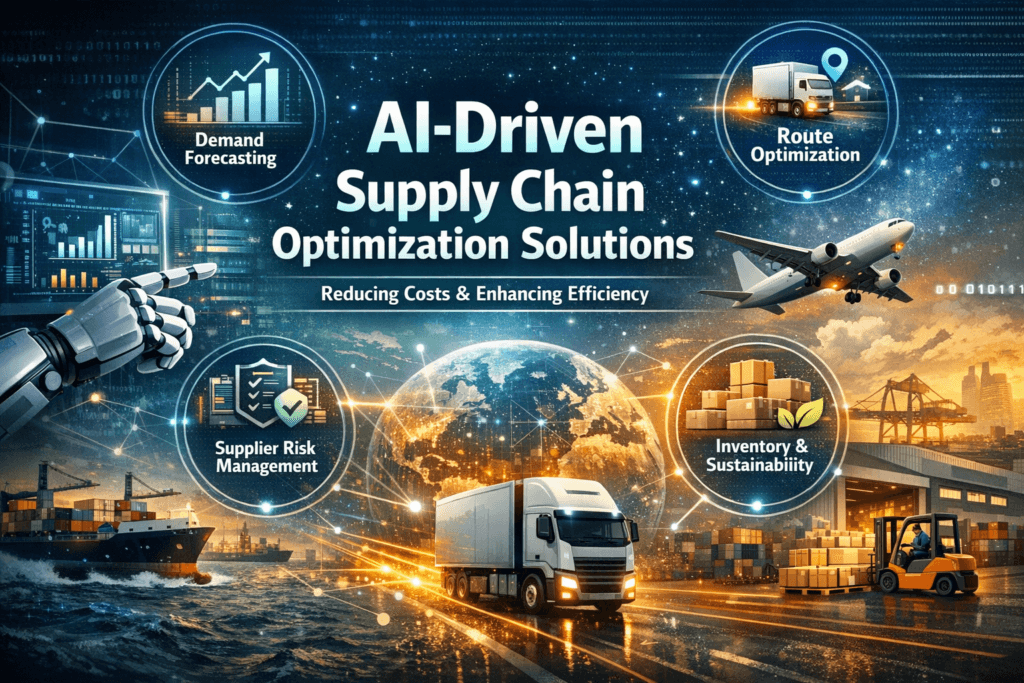
The capability of AI to execute real-time, extensive amounts of data, identify patterns, and derive inferences is the main focus of modern supply chain optimization solutions. For example, such algorithms can be used to conduct demand forecasting with a higher degree of accuracy and reduce the risks of excess inventory or stockouts, directly influencing profitability. Similarly, AI-based route optimization will help decrease transportation costs on the basis of the most efficient routes to be used in the deliveries. As a result, it will decrease fuel consumption and increase vehicle utilization.
3. Automation and Operational Efficiency
Really, AI plays a decisive role in automating supply chain activities which are generally considered to be monotonous as well as labor-intensive. Automation takes care of procurement and selection of suppliers through warehouses and order fulfillment, and also saves on labor and increases the precision and speed of business.
Besides spotting data inconsistencies, such systems will foresee the potential problems that can come out of them and suggest how these should be addressed before a problem becoming apparent.This helps businesses avoid problems like having their own inefficiencies and delays which will lead to additional expensive within-company inefficiency and delays.
4.Supplier Collaboration, Risk Management and Business Strategy Outcomes
In addition, supply chain optimization solutions based on AI offer supplier collaboration and risk management. This involves evaluating supplier analysis, price variations, and any risks that may be incurred to make better sourcing decisions and negotiate better contracts and eventually lower the procurement costs.
Overall, nowadays, in a world where margins are always tight, the use of AI-based strategies is not a progressive step anymore but a necessity. AI-driven supply chain optimization solutions do not just promise enormous cost reductions but also increase the agility, resilience, and performance of supply chain management, which guarantees business success in the long term.
Why Supply Chain Optimization Solutions Are Needed Now
Supply chain optimization solutions are more necessary than ever in the modern business environment that is both changing fast and evolving. In particular, such challenges can be of different types, and businesses need to embrace supply chain optimization solutions.
Rising Operational Costs
This decade has been quite a roller coaster ride for many companies due to rising operational costs. Consequently, these costs are fast burners of profits without optimization. Thus, they require intelligent planning, inventory, and cost-efficient logistics to be financially healthy at this point.
Demand Uncertainty and Volatility
There is no longer stability and predictability of customer demand. As a result, the volatile fluctuations in purchasing behavior and seasonality of demand are both negatively affecting the right amount of inventory. However, optimization helps companies to align their resources with data-driven demand forecasts in order to leverage the actual demand and avoid both resource wastage and loss of sales.
International Shocks and Threats
Among such events that have been exposing weakness in the traditional supply chains are pandemics, geopolitical tensions, and trade restrictions. Therefore, companies have become aware of the necessity of creating resiliency and flexibility in their systems that can respond to disruption rapidly, which optimization can facilitate.
Increasing Customer Expectations
The contemporary consumer is demanding accurate tracking, faster delivery, and the availability of products at all times. If not, when these expectations are not achieved, the customers and reputation of the brand will be lost. Thus, it can be fulfilled more quickly and enhanced in the extent of service.
Multi-layered and Interconnected Networks
The supply chains today usually entail numerous suppliers, nations, and means of transportation. Because of this, complexity cannot be handled manually easily and efficiently, and it is also error-prone.
Hence, optimization refers to bringing automation and sophisticated analysis to make operations easier and simpler.
Additionally, with the ever-growing use of artificial intelligence and big data, they have been in a position to use advanced tools to complement decision-making in businesses. Instead, a firm will lose its competitive edge to its rivals if they don’t work on AI. Those competitors who employ AI will work on the maximum use of their resources. Thus, they can reduce the heavy expenses of the business that they are conducting.
Waste Minimization and Sustainability
Business pressure these days is growing to lessen the impact on the environment. Accordingly, streamlined supply chains minimize wastage and minimize routing emissions as well as optimize more sustainable operations.
Companies that embrace the supply chain optimization solutions are advantaged. In other words, the advantages of such organizations are their optimized performance, which creates a competitive advantage, and acquires optimized responsiveness to customer demands, which guarantees business sustainability (Baryannis et al., 2019).
In short, optimization of the supply chain is no longer an option. Rather, it is a strategic imperative because of the cost pressures, uncertainty in the market, and changing customer demands. Optimization of the supply chain is no longer an option but a strategy that must be embraced because of the cost pressures, market uncertainties, and changing customer expectations.
Supply chain optimization solutions have certain challenges. The past ten years have rendered supply chains complicated. Therefore, it implies that the traditional planning systems, based on the use of historical data and manual planning, cannot respond to real-time changes effectively.
Key Challenges in Supply Chain Optimization Solutions
The volatility of the demand is predetermined by e-commerce and the short life cycles of the products.
Increasing costs of logistics and fuel
Risks in the supply chain and suppliers
Stock imbalance (overstock vs. stock out)
Cannot visualize the network in real-time
Thus, the AI-based systems are great in removing these deficiencies as they will analyze large volumes of data and eventually make predictive and prescriptive decisions.
AI-based Supply Chain Optimization Solutions of the Future
AI not only automates the processes alone; it transforms the paradigm of decision-making in the supply chain. In other words, instead of having to make decisions that are based on real events and situations, the decisions can be optimized.
Principal AI Supply Chain Capabilities in Supply Chain Optimization Solutions
At its core, AI can offer several significant advantages to a business’s supply chain.These include the use of AI predictive analytics, which helps companies better forecast how much of a product or service they should supply or how many of them will be in short supply.
AI also offers real-time automation that can identify the most profitable path to reach different types of customers and even manage orders automatically at the level of an individual customer.
Predictive Analytics: Better forecasting of demand.
Authoritative Suggestions: Suggest the most appropriate action (e.g., rearrange quantity, routing judgments).
Dynamic Optimization: Use real-time information to create dynamic changes to operations.
Automation: Automation reduces human interaction in designing and execution.
Major Elements of AI-Powered Supply Chain Optimization Solutions
1. Demand Forecasting
Traditional forecasting can involve the use of historical averages.
20–50 percent decrease in the error in the forecast.
There is an enhancement in service levels.
Smaller safety stock buffers.
2. Inventory
AI finds the optimal level of inventory in a multi-location.
Utilization in Use Cases
Multi-echelon stock preparation.
Real-time safety store calculation.
Automated restoration.
Advantages
Store costs are reduced.
Lower stockouts.
Working capital supervision.
3. Routes and Optimization of Transportation
AI-based transportation and route optimization.
Traffic conditions and fuel costs.
Delivery timing.
The vehicle capacity.
Results
Reduced fuel efficiency.
Smaller delivery time.
Better fleet utilization.
4. Supplier Risk Management
Analyzing previous supplier performance.
Financial statements.
Geopolitical indicators and news outputs.
Optimization
Proactive risk management.
Vendor diversification.
Best Cases of Implementing Supply Chain Optimization
Predictive logistics on a scale.
Amazon has been using AI to a great extent in the following:
Forecasting customer needs and managing inventories.
Improving delivery to customers’ doorsteps.
Innovative Feature (key innovation)
Anticipatory shipping: The ability to know what customers are going to order even before they order it.
Deliverable
Delivery times reduction.
Walmart
Walmart is implementing a system that monitors what people are purchasing.
This system attempts to determine what people desire.
It also monitors the stock levels at all times in order to know when it is time to stock something.
Outcome
This aids in ensuring that there are products when individuals desire to purchase them.
It makes shoppers happy.
DHL
DHL has a system that assists them in planning the routes of their trucks.
The system also assists them in maintaining their trucks in good condition to prevent breakdowns.
Outcome
DHL can operate its operations in a manner.
Delivery efficiency.
Other Real-World Case Studies of Supply Chain Optimization Solutions
Unilever
AI-based supply chain optimization systems.
Enhances demand forecasting.
Waste minimization in international businesses.
Result
Highly efficient and sustainable supply chain.
Zara
Fast reaction to fashion trends.
Use of sophisticated data analytics and AI.
Result
Stops overproduction.
Increases frequency of stock turnover.
UPS (ORION System)
ORION – OnRoad Integrated Optimization and NavigationInnovation in route planning powered by artificial intelligence.
The Outcome
Prevention of millions of gallons of waste fuel each year.
Reduces delivery times significantly.
Evidence-Based Advantages of Supply Chain Optimization Solutions
Industry data shows measurable improvements from AI adoption:
Inventory costs reduced by 10–30%
Logistics costs reduced by 5–15%
Service levels improved by up to 65%
Forecast accuracy improved by 20–50%
Additionally, according to IBM, AI-enabled supply chains are more resilient and can respond faster to disruptions compared to traditional systems.
Conclusion
Optimization of supply chain solutions using AI is no longer a luxury but an essential requirement that organizations must have to be able to stay competitive in the fast-changing world. Ultimately, predictive analytics, real-time optimization, and intelligent automation can assist enterprises in cutting the costs by a big margin but enhance efficiency and resilience.
The industry leaders are not only adopting AI, but also integrating it in their decision making. Thus, it might be optimization of inventory, logistics, or supplier risk, nonetheless, in any case, AI can lead to actionable insights which can be translated into measurable results.
Business owners and supply chain managers can invest in AI-powered supply chain optimization solutions, focus on specific use cases, and scale successfully, which is the way forward. Besides that, cost savings will be realized by early adopters, and those who can create agile supply chains will have the ability to withstand disruptions.
FAQs
1. How can AI-driven supply chain optimization solutions lead to cost reductions?
One of the primary methods where AI-driven supply chain optimization solutions can bring down costs is by increasing the accuracy of demand forecasting, streamlining the choice of transport routes, automating monotonous tasks, and slashing inventory holding expenditure.
2. Why are supply chain optimization solutions a must-have right now?
There are many reasons why supply chain and its optimization solutions have become not just a desire but a necessity. However, one of them is increasing operational costs, not to mention demand fluctuations, global disruptions, and the ever-increasing customer expectations for faster and more reliable delivery.
3. So, which sectors are the most benefiting from supply chain optimization solutions?
Industries that mainly depend on accurate inventory management and distribution networks can most benefit from supply chain optimization. Such industries include retail and manufacturing. Similarly, logistics, e-commerce, and consumer goods.
4. Then, what are the major advantages that supply chain optimization solutions may bring?
The main advantages of supply chain optimization solutions are, first of all, cutting costs; increasing efficiency of operations; getting more visibility; forecasting the demand more accurately; risk management and, of course, better customer satisfaction.
5. What role does AI play in demand forecasting as one of the supply chain optimization solutions?
AI is really the best tool for strengthening the demand forecasting function because it is capable of handling huge volumes of data. Likewise, identifying changes in market trends, modeling seasonal changes, and even doing a real-time update with the new data. Thus, it gives the most precise forecasts with the minimum number of errors.
6. What issues can supply chain optimization solutions address?
Supply chain optimization solutions have the potential to totally digitize the entire supply chain and therefore help in solving the common problems that arise. It includes demand fluctuations, increased logistics costs, supplier risks, inventory inaccuracies, inability to see the operations in real-time, etc.
In fact, supply chain solutions that are integrated with AI tools, which are highly scalable and cloud-based platforms, can not only drastically improve the productivity of small businesses but also lower their operating costs.
There are a lot of developments that are expected to revolutionize the supply chain optimization solutions. For instance, they are autonomous supply chains, digital twins, real-time decision making, sustainability optimization, and hyper-personalization that is driven by artificial intelligence.
7. How do companies go about implementing supply chain optimization solutions?
The steps that a company can take include a thorough examination of its demand forecasting and inventory management processes, followed by the establishment of a comprehensive data environment. Subsequently, companies can introduce AI-powered tools and expand upon these technologies.
Umaimah is an SEO strategist with 5+ years of experience in digital content and growth systems. She founded Ambition Inside to publish structured, research-driven insights on productivity, career strategy, and AI-driven business growth. Learn more on the About page.










This outline is well structured and covers every important angle of supply chain optimization!
Thank you.
Excellent article
Thanks.