Unlocking success is the very beginning of the journey when you set clear and practical goals that show you the way ahead. One common thing among every groundbreaking achievement is that a person must first of all have his or her goals set right. 🎯 Indeed, goals are vital not only in personal life but also at the workplace. They provide individuals with the ability to accomplish amazing things that could even be considered impossible, for example, establishing a company, creating an effective project, or finalizing a deal worth a billion dollars.
By defining clear objectives, one envisions a better future and becomes prepared to bring it about. 🌟 Ambitious dreams, however, do not remain merely as vague aspirations. To make those dreams come true, we have to be dedicated to achieving the success that will lead us to the desired results by using specific and well-organized goals. Furthermore, setting goals through the SMART model is what really counts.
SMART goals provide us with the necessary precision and clarity to implement detailed plans that might otherwise remain only as vague visions. Consequently, the SMART goals method is an outstanding framework for setting goals. It makes people set their objectives clearly and directs their efforts. 🧭
This is a complete and thorough manual where we comprehend the structure of SMART goals, learn their elements, and acquire techniques of how to actually do it. So, let’s get started.
What Are SMART Goals? – Unlocking Success with Clarity and Structure🧠
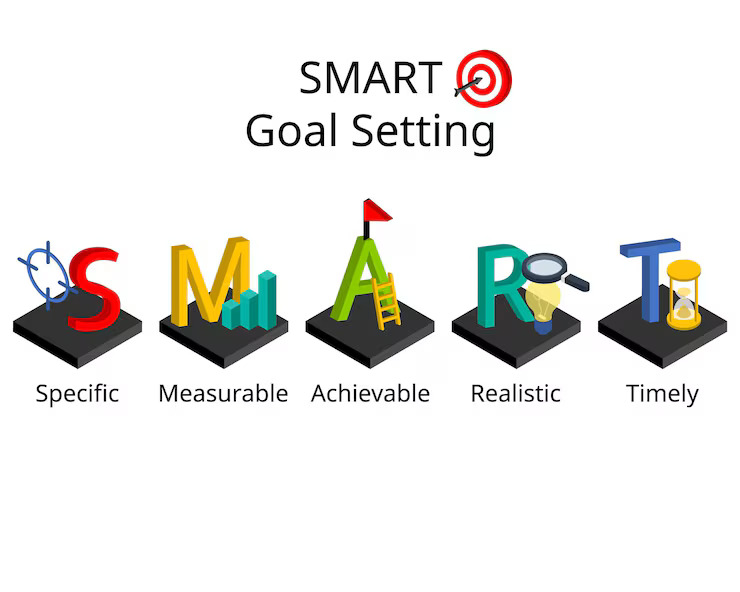
Before we get to know more, we have to figure out what SMART goals mean in the first place. The SMART criteria refer to:
Specific
Measurable
Achievable
Relevant
Time-bound
It is a system for setting and achieving realistic, honest, clear, and achievable goals.✅
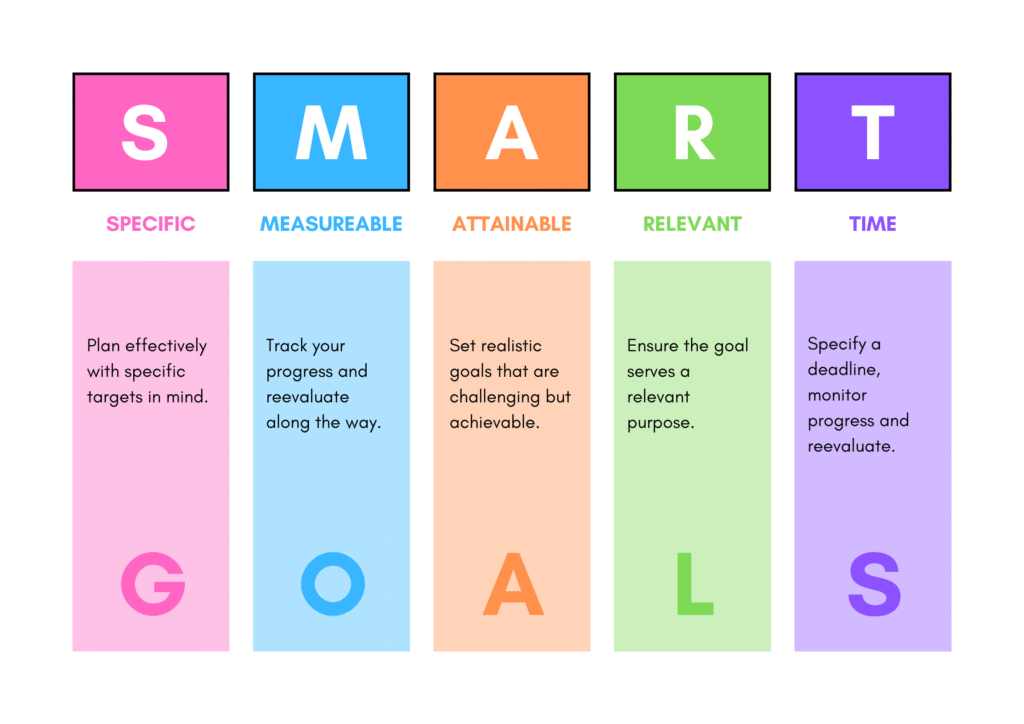
Each element of the SMART framework highlights the vital issue of goal formulation:
Specific: Goals need to be well-defined and detailed.
Measurable: An individual should be able to monitor their advancement.
Achievable: The purposes should be rational and within the reach of the person.
Relevant: Your goals should align with your values and long-term plans.
Time-bound: Have a time indicator by which the goal should be reached.
👉Fact: Research at Dominican University revealed that individuals who document their goals are 42% more likely to accomplish them. Besides, applying the SMART method makes those written goals even more attainable.
The Importance of SMART Goals – Strategic Planning🔑
Clearly, the SMART framework helps a person keep concentration and motivation, as well as provide a route to success. Above all, its worth is in the practice of goal setting, becoming clearer through the SMART method.
To set SMART goals, one must thoroughly think through what they want to achieve, how to measure progress, and what difficulties they may face. Moreover, it engages the person in thinking ahead and making a plan.
Now, let’s turn to the purpose of writing about the various benefits of SMART goals.
1. Clarity and Precision – Unlocking Success with a Clear Vision🔍
Creating SMART goals allows you to specify your desired outcomes in very clear and exact terms. In that process, they assign you a particular aim, which lessens the amount of ambiguity and misunderstanding.
Hence, this feature enables you to map out a thorough action plan, ensuring that you direct every single effort toward a clearly defined target.
👉 Fact: According to workplace productivity studies, employees who set structured goals demonstrate over 20% higher task completion rates than those without clear goals.
2. Monitoring Progress – Unlocking Success Through Measurable Outcomes📊
The Measurable element of SMART goals is essential to a large extent in reviewing your progress and determining if you are moving in the right direction.
One of the benefits of having precise and measurable objectives is that you can visualize how your progress unfolds over a period of time. Also, it keeps you motivated, feeling good about your progress, and making changes if the plan requires.
👉 Example: Suppose the aim of your goal is running a 10K race within 3 months, then by keeping a record of your weekly distance and time you run, you will always know whether you are making progress or not.
3. Realistic and Relevant Goals – Unlocking Success with Practical Objectives 🧩
SMART goals make it possible for your objectives to be real and adequate. To put it simply, attainable goals take into account the means and the capabilities. This helps prevent disappointment due to unachievable expectations.
Besides that, relevant goals tie with your bigger dreams, giving you purpose and energizing you to keep on track with your commitment.
👉 For instance: A university student aiming to save $2,000 within six months by doing a part-time job is a goal that is both achievable and relevant, particularly if the long-term goal is financial independence.
4. Time-Driven Focus – Unlocking Success by Setting Deadlines⏳
The Time-bound component defines a definite end date for your objectives, which in turn generates a need for action and helps identify the most important activities. A certain period, such as “get a certificate in six months,” not only makes a continuous move but also limits the tendency to put off the task.
👉 Fact: According to a study done by Parkinson’s Law, “work is expanded to such an extent that it fills the time available for its completion.” So, time-limited objectives are the ones that help times of procrastination to be avoided.
Breaking Down the SMART Criteria – Unlocking Success Step by Step🪜
Now, let’s take a closer look at each element of the SMART framework:
1. Specific – Unlocking Success with Clear Objectives 🧭
The “Specific” aspect requires clearly defining your goals. Therefore, it is advisable to avoid vague goals.
Example:
✔️ “I want to lose 10 pounds in 3 months by exercising five days a week and eating healthy.”
❌ “I want to get fit.”
2. Measurable – Unlocking Success with Trackable Progress📏
A goal that is measurable allows you to see how much you have advanced through specific metrics. Such a method gives you a clear picture of your progress as well as how much you will achieve in future.
Example:
“Losing 10 pounds gives a quantifiable benchmark. You can monitor your weight loss regularly to stay on track”.
3. Achievable – Unlocking Success Within Your Limits💪
One achievable goal is to be practical and account for the resources and skills that you have. Instead of setting yourself up for disappointment, you can attain achievable milestones through SMART goals.
Besides that, a person who sets achievable goals would feel more confident and consistent in their efforts.
Example:
“I want to lose 10 pounds in 3 months is a more realistic goal than to shed 50 pounds in 1 month“.
4. Relevant – Unlocking Success Through Purpose-Driven Goals🎯
The relevant goal will be in harmony with your life and work aspirations. Consequently, this will give you a sense of purpose and make the progress you make common ground between you and your personal values.
Moreover, being congruent with your values will help you to have a strong commitment when holding on in the long run.
Example:
Workout goals can go hand in hand with your long-term goal of adopting a healthy lifestyle, but overworking and neglecting health will not.
5. Time-bound – Unlocking Success with a Deadline📅
For goals to be achieved, they should have a time frame that creates an impression that immediate action is necessary. Without a deadline, the desire to achieve the goal may weaken, and what was previously considered necessary may become less so. On that account, setting a time in one’s goal increases not only accountability but also motivation.
Example:
The phrase “I want to lose 10 pounds in 3 months provides a time frame”.
The goal “I want to lose weight” is less effective as it is not clear.
How to Set SMART Goals – A Proven Framework🧰
Using the SMART framework to set goals is basically knowing exactly what you want to do and following the five criteria:
Clarify the objective: Describe the goal you want to attain.
Measure progress: Determine specifically how to monitor progress using numbers.
Assess achievability: Check that the goal is reasonable and fits your available resources.
Ensure relevance: Make sure it is consistent with your principles and bigger goals.
Set a deadline: Giving a definite period of time.
Example SMART Goal: Enhance Leadership Skills🧑💼
Specific: Take a management training course.
Measurable: Achieve an 85% score or above.
Achievable: Study for 5 hours each week.
Relevant: A key point in the professional development plan.
Time-bound: Complete the task in 3 months.
Conclusion – Unlocking Success with Worthy SMART Goals 🎯
Unlocking success is not possible without starting with step-wise clear intentions and making an achievable path that moves forward. This is exactly the type of goal that the SMART framework allows you to set. In case you have a desire to promote your career, maintain your health, or achieve your own milestones, the SMART objectives will give you the clarity, the framework, and the motivation to convert your goals into reality.
By transforming your goals into Specific, Measurable, Achievable, Relevant, and Time-bound goals you are not merely dreaming success, you are making a detailed plan to achieve it. Besides, every element acts as an inspection point that cares if your aims are targeted, quantifiable, and driven by a strong reason.
Keep in mind that success is not a matter of luck. It results from a good strategic plan and regular effort. So, go through the process of setting your goals using the SMART method and you will be on the path to success, one mindful step at a time. 🚀✅
Umaimah is an SEO strategist with 5+ years of experience in digital content and growth systems. She founded Ambition Inside to publish structured, research-driven insights on productivity, career strategy, and AI-driven business growth. Learn more on the About page.












Pingback: High Achievers: The 90-Day Life Reset Plan