Goal-tracking tools are essential for turning our wishes into tangible outcomes. However, the habit of most people still remains unchanged. They are very enthusiastic in the beginning but within weeks, they get lost again. The main reason is very simple. Without reflection on your progress, your drive will drop and your brain will move away.
It is becoming very difficult to concentrate and be consistent as we are constantly distracted not only at work but in our everyday lives. And this is why these dependable tools are so valuable. They allow you to give structure to your thoughts, keep you accountable, and maintain your energy level over time.
For me, being a writer and a digital content creator, instead of stress or burden, goal tracking means nothing more than awareness and self-improvement. It sheds light on your behaviors, brings to your attention what is missing, and motivates you to keep moving forward.
In this article, the author reviews the advantages of using the best goal tracking tools. It explains their operating principles, their significance, and how they can be a great help to consistency and success over time.
To apply everything discussed in this article, you need a reliable system. The following are some of the most effective tools. Thus, they are used by professionals, creators, and productivity experts.
1. Notion – Best for All-in-One Goal Management
Notion allows you to create custom dashboards for:
Goals
Habits
Weekly progress
Long-term plans
It is ideal for people who manage multiple life areas such as career, health, and personal growth in one place.
2. Todoist – Best for Daily Action Tracking
Todoist is excellent for turning goals into daily actions.
It helps with:
Task lists
Recurring habits
Priority setting
Streak tracking
However, this makes it without feeling overwhelmed much easier to stay consistent.
3. ClickUp – Best for Professional and Team Goals
ClickUp is widely used by teams and professionals.
It offers:
Goal tracking
Task breakdowns
Progress bars
Performance tracking
This is especially useful for career goals, business projects, and long-term professional plans.
4. Google Sheets – Best for Simple and Custom Tracking
Many high-performers use spreadsheets for goal tracking because they:
Are fully customizable
Make progress easy to see
Encourage weekly reflection
A simple sheet can track:
Goals
Weekly actions
Progress percentages
Notes
5. Habitica – Best for Motivation and Habit Building
Habitica turns your goals into a game.
You earn rewards for:
Completing tasks
Building habits
Staying consistent
In short, this is best and very useful for people who struggle with procrastination and motivation.
Personal experience
“Initially, I saw motivation simply as a tool to get myself up and running. Gradually, I realized that motivation doesn’t last. Through setting goals with the simple tools I use, I become very clear and consistent without the sense of being overwhelmed.”
Why Goal Tracking Tools Matter More Than Motivation
In contrast, motivation is temporary. Discipline alone is exhausting. However, goal tracking tools create structure.
When progress is visible, effort feels meaningful. Even small improvements become motivating.
Research in behavioral psychology shows that people will complete long-term goals who track their progress. This is because tracking reinforces positive behavior and reduces uncertainty.
In simple terms:
What gets measured gets improved.
What is tracked stays visible.
What is visible stays prioritized.
Therefore, these tools bridge the gap between intention and action.
Goal Tracking Tools and the Psychology of Consistency
How Tracking Builds Consistent Habits
Goal tracking tools support consistency by reducing decision fatigue. Instead of asking “What should I do next?”, the tool already provides direction.
Consistency improves when:
Goals are clearly defined.
Progress is recorded regularly.
Feedback is visible.
As a result of these habits forming naturally over time.
Why Consistency is Essential and Beats Intensity
Many people work intensely for short periods. Then they stop.
However, these tools encourage small, repeated actions. Over time, these types of actions compound.
This is why consistency produces better results than unsustained effort.
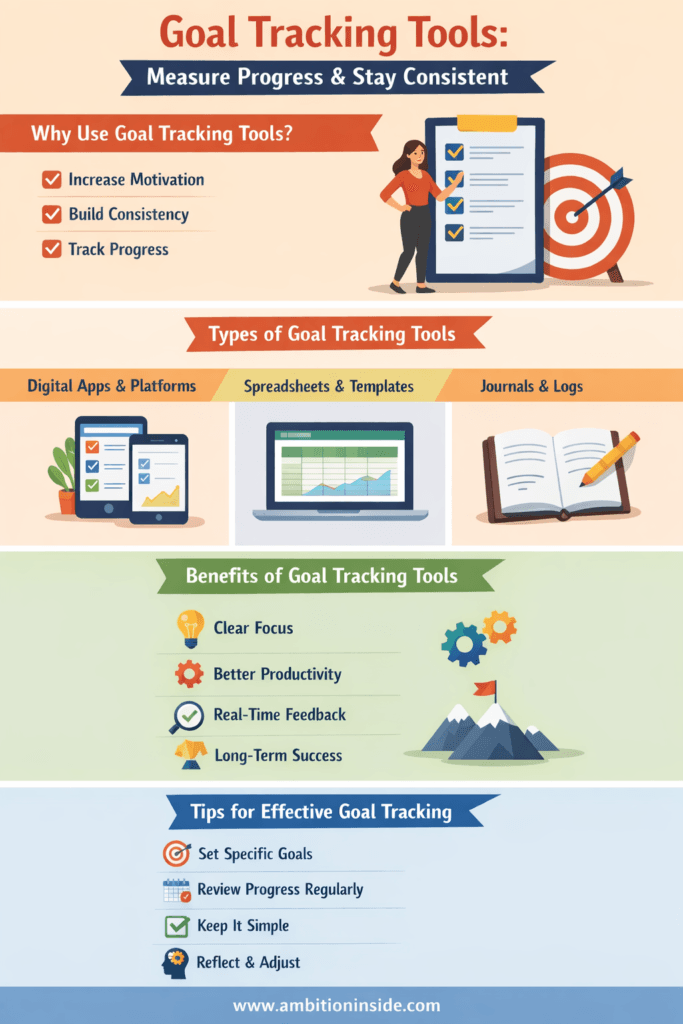
Types of Goal Tracking Tools You Can Use
Not all goal tracking tools are digital. In fact, the best and right tool is the one you use consistently.
Below are the main categories.
Goal Tracking Tools: Digital Apps and Platforms
Why Digital Goal Tracking Tools Are Popular
Digital goal tracking tools are popular because they:
Are accessible anytime
Offer reminders
Visualize progress
Store long-term data
These features reduce friction and increase follow-through.
Examples of Digital Goal Tracking Tools
Common types include:
Habit tracking apps
Task management platforms
Calendar-based trackers
Progress dashboards
These tools are the ones that are especially helpful for professionals managing multiple goals.
Goal Tracking Tools: Spreadsheets and Templates
Why Simple Tools Still Work
Not everyone needs complex software. In fact, spreadsheets are highly effective.
They allow:
Customization
Clear structure
Manual reflection
Many high-performing individuals still use spreadsheets for goal tracking.
Example Use Case
A simple spreadsheet may include:
Goal description
Weekly targets
Progress percentage
Notes or reflections
This approach thus builds awareness and accountability.
Goal Tracking Tools: Journals and Written Logs
The Power of Writing Goals Down
Writing goals activates deeper cognitive processing. As a result, goals feel more real.
Goal journals support:
Reflection
Emotional clarity
Long-term commitment
From my experience, writing goals helped me understand why certain goals mattered more than others.
Personal experience
“When I started writing down my goals weekly, I saw the patterns of my behavior. That allowed me to change the expectations and keep on track without being hard on myself. “
Goal Tracking Tools for Professional Growth
Why Professionals Need Goal Tracking Tools
Work environments are complex. Deadlines overlap and priorities change.
Goal tracking tools are the best as they help many professionals:
Stay focused on high-impact tasks
Measure real progress
Avoid burnout
One of the benefits of tracking progress is that it reduces stress, as expectations become clearer.
Goal Tracking Tools for Productivity and Focus
How Focus Gets Better with Tracking
If you can focus more when there are fewer distractions. Goal tracking tools give you a clear picture.
Users don’t simply react to tasks; they take deliberate actions. It helps to cut down:
Feeling overwhelmed
Putting off stuff
Getting tired of making decisions
The outcome is that productivity can be maintained consistently.
Goal Tracking Tools for Long-Term Goals
Why Long-Term Goals Need Tracking
Long-term goals often fail because progress feels invisible.
Goal tracking tools solve this by:
Breaking goals into smaller milestones
Highlighting incremental progress
Reinforcing patience
Over time, this builds confidence.
Goal Tracking Tools and Feedback Loops
Why Feedback is Essential and Why it Matters the Most
Feedback is essential for changes and improvement. Without it, mistakes repeat.
Goal tracking tools create feedback loops by showing:
What works
What doesn’t
Where adjustments are needed
This allows for continuous improvement.
Common Mistakes When Using Goal-Tracking Tools
Even the best tools fail if used incorrectly.
Common mistakes include:
Tracking too many goals at once
Focusing only on outcomes, not actions
Being inconsistent with updates
Using overly complex systems
Simplicity increases sustainability.
How to Choose the Right and Best Goal Tracking Tools
Essential and Right Factors to Consider
When selecting goal tracking tools, consider:
Ease of use
Flexibility
Visibility of progress
Alignment with your goals
The best and the right tool is the one you will actually use.
Goal Tracking Tools and Personal Accountability
Why Tracking Builds Accountability
Tracking creates a sense of responsibility. When progress is recorded, avoidance becomes harder.
This internal accountability is more effective than external pressure.
Personal Insight
“Once I started reviewing my tracked goals weekly, I stopped making excuses. The data was clear, and it helped me take responsibility calmly.”
Goal Tracking Tools for Different Teams and Collaboration
Why Teams Benefit from Shared Tracking
Teams perform better when goals are transparent.
Shared goal tracking tools help:
Align expectations
Improve communication
Track collective progress
This reduces misunderstandings and increases trust.
Goal Tracking Tools and Data Awareness
How Data Supports Better Decisions
Tracking generates data over time. This data reveals patterns.
This is good for one’s psychological condition in the long run.
Best Practices for Using Goal Tracking Tools Effectively
To get the most value:
Review goals weekly
Track actions, not just results
Keep systems simple
Reflect regularly
Consistency is not only important but also right and preferable to perfection.
Real-Life Example of Goal Tracking Tools in Action
Consider a professional working on their career growth.
Without tracking:
Progress feels slow
Motivation fluctuates
With tracking:
Weekly achievements are visible
Adjustments are easier
Confidence grows steadily
This illustrates why goal tracking tools are powerful.
Goal Tracking Tools and Long-Term Success
Long-term success is the one that results from consistent effort and rarely comes from sudden breakthroughs.
Goal tracking tools support this by:
Reinforcing daily habits
Highlighting progress
Encouraging reflection
Over time, small improvements compound.
When Goal Tracking Tools Don’t Work
Tools fail when:
Goals are unrealistic
Tracking becomes obsessive
Reflection is ignored
Balance is essential.
Tracking should support life, not control it.
How to Start Using Goal Tracking Tools Today
Start simple:
Choose one tool
Track one goal
Review weekly
Gradually expand as habits strengthen.
Clarity and Direction When Using Goal Tracking Tools
Clarity is the foundation of progress. Without clarity, effort becomes scattered. Many people work hard but feel lost because they are unsure what truly matters. This is where goal tracking tools become valuable.
When goals are tracked, priorities become visible. Instead of vague intentions, actions gain direction. So, focusing becomes easier, and confusion is less of a problem.
Eventually, clarity breeds confidence as your choices don’t seem like reactions but rather deliberate actions.
Besides that, precise monitoring also lessens the pressure from emotions. If you are totally clear about your target, it becomes very difficult for distractions to tempt or affect you. Hence, one might say that goal tracking tools, at least indirectly, help maintain a person’s mental equilibrium.
Understanding Time Awareness Through Goal Tracking Tools
Time is one factor that often seems insufficient because it is difficult to measure. Hence, many people underestimate the time they spend on low-return activities. And if you are not aware of it, it will be extremely hard for you to improve.
Tracking progress toward goals using various tools significantly increases the time spent, as it makes it clear which actions lead to which outcomes. What happens is that after a while, in fact quite naturally, when tracking the progress with the respective amount of effort, patterns are able to emerge. You may be realizing that some of your activities unexpectedly take up a lot of time, while others, less demanding, deliver better results.
Through personal experience, I have realised that recording my time and goals together helped me see the distractions I was confusing for productivity, but which, in reality, hardly brought any value to me. So I altered my schedule and managed to get more work done without putting in extra hours.
Measuring Workload Instead Of Results With Goal Tracking Tools
Results need time to show up. Workload, however, happens every day. When people concentrate solely on outcomes, their drive typically vanishes even before the results materialize. Tools for tracking goals might help solve this issue by shifting focus away from the amount of work.
Tracking what is done every day gives a sense of pursuing something. Instead of questioning, “Did I succeed? “, the question changes to, “Did I show up today? ” This kind of thinking takes the pressure off and helps to be consistent.
Some effort-based tracking examples are:
The time spent on practicing a skill, the number of focused work sessions, and the days of consistent habits.
After some time, effort turns into results. Effort tracking makes the progress visible even when the results are delayed.
Using Goal Tracking Tools to Build Better and Long-Term Discipline
Discipline is not about exerting force. It is about providing a framework. Goal tracking tools help create a framework that makes discipline effortless.
When you keep an essential record of your actions, your behavior becomes conscious. You don’t have to depend on your motivation anymore. Instead, the system is the one that always helps you move forward.
This is essential, especially for long-term goals. Being consistent for months requires systems, not willpower. Goal tracking tools give you those systems and help you to succeed.
Supporting Personal Growth Through the Use of Goal Tracking Tools
Most of the time, your personal development goals are quite intangible and revolve around your mindset, habits, and emotional capabilities. Because of this, they are not easily measurable.
Goal tracking tools help clarify personal development by emphasizing behavior. Recording activities like reading, writing in a diary, or taking lessons gives clear insight.
Eventually, these little things will accumulate to a significant internal transformation. Monitoring results oneself, development ensures that growth is consistent rather than occasional.
Role of Goal Tracking Tools in Building Confidence Over Time
Where there is evidence, confidence is sure to arise. When you diligently track your progress, evidence naturally accumulates.
Every single action that you complete serves as proof of your ability. This sort of experience solidifies self-trust. However, if you don’t reflect on your evolution, your victories will be quickly covered up, if not entirely erased, and you will end up deceiving yourself into believing that you are standing still.
Goal tracking tools solve this problem by always depicting and quantifying your progress. Confidence develops internally, gradually and consistently.
Better Decision-Making With the Support of Goal Tracking Tools
Better decisions begin with better information. Personalized goal tracking applications can deliver this information to you gradually.
Once you have the data, it becomes easier to decide:
Which goals should your focus be on even more? Similarly, which habits require you to change? Which tactics are effective? Eventually, there are fewer emotional decisions to make. Guesswork is replaced by logic, and progress gets more predictable.
Applying Goal Tracking Tools Across Different Life Areas
Goal tracking tools are flexible. They apply to many areas of life, not just work.
Common areas include:
Career development
Health and fitness
Learning and education
Financial habits
Creative projects
Each area benefits from clarity, consistency, and feedback. Tracking creates balance across life domains.
Adapting Goals Effectively With Goal Tracking Tools
Life changes. Goals must adapt. Without tracking, adaptation feels like failure. With tracking, it feels like an adjustment.
Progress tracking tools make it clear what is achievable. Instead of giving up on the goal completely, it can be modified if progress data indicates that the same part is difficult repeatedly. From there, we see that there will be less stress, frustration, and burnout.
Adaptability is a strength, not a weakness.
How Tools Help Beat Procrastination
Procrastination is one condition that basically stems from getting overwhelmed. Major goals are scary to the extent that one is not even able to think about them. Goal tracking tools alleviate the problem by disaggregating the goals into the steps that can be easily accomplished.
You do not think of the whole task and what it entails when you do this but rather only the immediate step. That is why it is much more straightforward to initiate if there is a clear step to follow. So, once you get going, the habit of delaying things will vanish in such a way that you won’t even be aware of it.
Concerted minor efforts intensely measured bring about substantially significant advancements.
Accountability Without Adding Stress with the Help of a Goal Tracking Tool
External accountability can feel stressful. Internal accountability is healthier. Goal tracking tools create internal accountability through visibility.
Progress is recorded without judgment. There is no punishment, only information. This encourages responsibility without shame.
Personal Experience
“When I started observing my tracked progress instead of judging myself, consistency improved. The tool became a mirror, not a critic.”
Achieving Sustainable Success With Goal Tracking Tools
Sustainable success is achievable as it requires balance. Overworking leads to burnout. Underworking leads to regret.
Goal tracking tools help find balance by revealing patterns:
When effort is excessive
When rest is needed
When priorities require adjustment
Therefore, such a type of awareness can always lead to long-term success instead of a series of short-term wins.
Turning Goals Into a Learning System
Every goal is an experiment. Tracking transforms that experiment into a learning system.
In short, each cycle provides feedback. Over time, strategies improve. This mindset reduces fear of failure because every outcome becomes information.
Learning replaces judgment, and growth accelerates.
Identity Change Reinforced Through Goal Tracking Tools
Lasting change occurs when identity shifts. Goal tracking tools support this shift by reinforcing behavior.
When actions are repeated and tracked, identity evolves:
“I am consistent.”
“I follow through.”
“I complete what I start.”
Ultimately, this identity change is powerful and long-lasting.
Visualizing the Compound Effect With Goal Tracking Tools
Small actions accumulate. Tracking makes this accumulation visible.
Over weeks and months:
Small efforts create large outcomes
Minor improvements compound
Consistency outperforms intensity
Most notably, these tools clearly highlight this compound effect, reinforcing patience.
Setting Realistic Expectations Using Goal Tracking Tools
It is a proven fact that unrealistic expectations are among the main causes of disappointment. The thing is, tracking adds a sense of realism.
Hence, simply by looking at the real progress, expectations inevitably change. Consequently, there is less frustration and greater satisfaction. At the end of the day, realistic goals are the source of continuous motivation.
Why Goal Tracking Tools Become a Long-Term Companion
Goal tracking tools are not temporary fixes. They are long-term companions.
As goals evolve, tools adapt. Likewise, as goals change, tools adjust. Besides, the most important thing is the habit of tracking, not the way of doing it. This habit is the basis of lifelong development and constant progress.
How Tools Help Maintain Momentum Over Time
Above all, keeping up momentum is generally more difficult than setting goals. A lot of people are full of energy at the beginning, but they slow down over time as they wait for results. But in fact, goal tracking tools aid in this situation by making progress always visible and measurable.
Besides that, if progress is checked frequently, even the tiniest accomplishments look quite significant. Hence, people get motivated to go on instead of giving up. On the other hand, if there is no progress, one can feel that his/her efforts are going unnoticed, hence, disheartened.
Furthermore, these tools give rise to a feeling of continuity. What has been done today is linked to yesterday’s progress through every recorded action. So, discontinuing becomes less attractive because the momentum has already been created. Meanwhile, such regularity lessens dependence on motivation.
To illustrate, a glance at the weekly goal tracker would disclose a higher level of achievement than initially thought. Subsequently, one becomes more confident and determined. That is to say, tracking is a way of turning effort into tangible evidence of progress.
In the end, these tools help sustain momentum by fostering consistency rather than high energy levels. As a result, such gradual momentum without a break will become a long-term achievement.
Strengthening Strong Commitment and Follow-Through With Goal Tracking Tools
If a goal is vague or far away, commitment will most likely diminish. In fact, quite a few of us intend to carry out the plan, but the will fades over time. Luckily, these tools are a great help for commitment, as they provide clarity and a system.
Besides that, the mere fact that one’s deeds are automatically monitored goes hand in hand with increased accountability. Consequently, such persons have a bigger chance of finishing what they have started. On the other hand, a goal that is not being monitored is much more likely to be overlooked, as there is no indication of progress.
Moreover, these tools make it harder for one to find excuses. When one’s progress is honestly documented, it is only natural that the person becomes aware of different patterns. Hence, the quality of the follow-through improves, as even the emotion of the moment no longer and influences performance. At the same time, this kind of arrangement is more comforting than pressurizing.
In summary, these tools, by showing progress, make it steady, thereby encouraging completion rather than abandonment and supporting commitment.
Why Tools Support Sustainable Progress Without Burnout
Meanwhile, burnout is one of the most common problems people face when working toward long-term goals. Overdoing it, setting unattainable goals, and being under pressure all the time are some of the ways to get exhausted. But, goal tracking apps can be of great help in avoiding burnout as they encourage balance and help users to be more aware of their actions.
For example, if you track your effort over a period of time you will see when your workload gets too heavy. Therefore, people will be able to slow down even before the point of exhaustion. So, put it simply, tracking is like a warning signal for when things go too far.
Moreover, these tools lead to more grounded planning. Hence, progress will seem manageable rather than shocking. Whereas, neglecting progress usually causes either overexertion or giving up.
However, the most significant thing is that consistent progress, and not going all out, is what really matters.
Thus, these tools enable one to stay on the right track at a reasonable speed thus safeguarding one’s mind and body.
The Role of Tools in Maintaining Long-Term Motivation
Nonetheless, the original source of long-term motivation, such as goal achievement, is said to generally be exhausted once goal attainment is no longer readily attainable and a goal is no longer new.
Many people lose interest, not really because the goals are unimportant, but because the progress is very far; and this is the point. Hence, these tools help one maintain motivation by making their efforts visible.
Besides, without interruption, when achievement is up to date, even the smallest victories are more easily appreciated.
Apart from that, when progress is consistently tracked, it becomes easier to identify minor achievements. Therefore, motivation gets recharged even when the going is tough. On the other hand, goals that are not tracked often give the impression of being stagnant which leads to a reduction in enthusiasm.
Also, these tools can remind us of all aspects of a given task. Each time an individual’s memory or, most generally, a personal diary, is refreshed, it is another time that the rapport between that person and their aim is strengthened.
As a result, motivation isn’t driven by emotional ups and downs but by a steady mindset, which helps people stay consistent over time
In short, through a number of interrelated mechanisms, it becomes clear that goal tracking is essential in goal setting and achievement.
Conclusion
At the end of the day, all of these tools are a lifesaver for those who want to quantify their progress and keep working consistently. In addition, they serve as a source of clarity, an organizing method, and a tool of accountability amidst the distractions of our times.
Based on actual experience and practical examples, goal tracking helps convert motivation into lasting action. And, it doesn’t matter whether it’s through digital apps, spreadsheets, or journals; the right tools therefore become a great help to anyone in staying focused, making wiser choices, and ultimately winning.
The most crucial aspect of these tracking tools is that they essentially convert your striving into tangible progress and your ambitions into real results. These results build self-belief, which is a strong foundation for both personal and professional growth.
Umaimah is an SEO strategist with 5+ years of experience in digital content and growth systems. She founded Ambition Inside to publish structured, research-driven insights on productivity, career strategy, and AI-driven business growth. Learn more on the About page.













You’ve perfectly captured why most goals fail—and offered real tools to make them stick. Really appreciate the practical wisdom in your writing!
Thank you.